Saturday, 10 November 2012

Susupe Lake!


Once an area where native fish grew, the Susupe Lake's fish were killed off when Tilapia was introduced back in the 1960's. It has now turned into an abandoned like site. Due to its smell of pollution, it not surprising to find out that rarely any people visit Lake Susupe, the only lake in Saipan. Ironwood trees (Carpinus caroliniana) and thick, tall reeds grow amongst the edge of the lake.  It is home to birds only found here in the Marianas.


All of the vegetation that grows around Lake Susupe isn't natural, meaning that it is a subclimax. Everything was cleared up by the Japanese during WWII to create space for growing sugar canes. 

With an abudance of water, these plants are easily thriving.
The head of the the reed plant. Notice how dense and thick these plants are!


Reeds sprout from the beneath the waters. I was actually surprised myself to have seen them. I've never noticed them anywhere else on Island. 

A destroyed bridge.

The reeds growing in abundance. 


This was the bridge in Susupe Lake before it was destroyed.


This is what remains today. 


Shells and plankton all densed together by the edge of the lake.


Surprisingly, dead fish also float amongst the edge of the river.


What was the cause? Lack of food? Suffocation? Pollution?


Fungi spreads throughout the decaying wood, feasting on its minerals.


Tiny fancy-tailed guppies (Poecilia reticulata)swim in the lake.


A dragonfly.


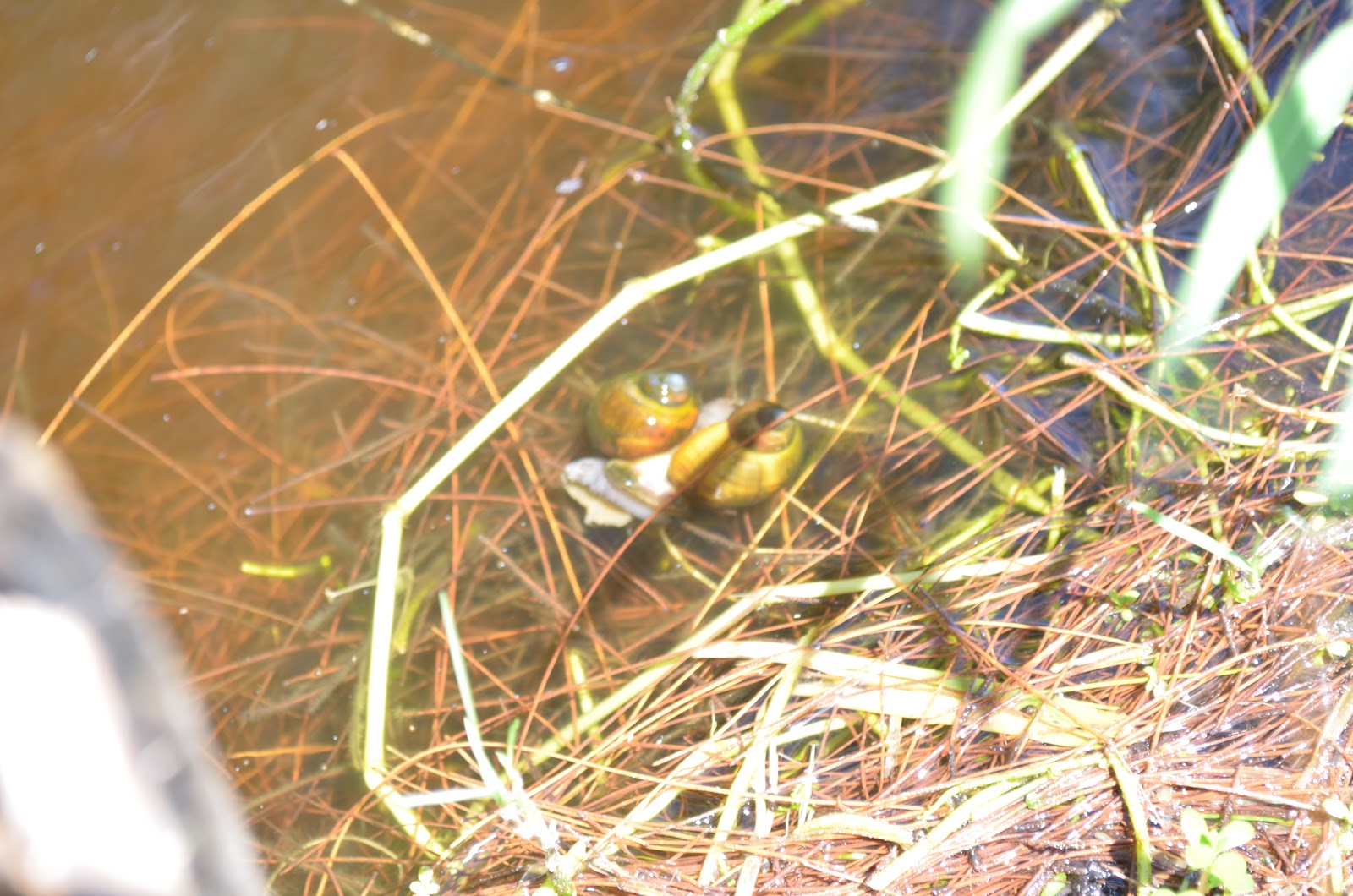
Two snails having intercourse in the lake! I found this behavior very odd. I would have never thought that it was possible in the water for these kinds of species. 


Disappointingly, pollution has built up around the lake. 


Kang-kong grows among the variety of plants.

The dark, mushy sand is the texture all around the lake.


The dead remains of a fish that has probably suffered a similar fate as of the fish earlier. This one has been lying around for quite a while now near a rock.


Monday, 5 November 2012

Beach Road!


The next location I scouted was around the Beach Road  area, specifically in front and behind Hardt's Eye Clinic. Fresh from the rain, I assumed that I wouldn't be able to see much bugs and animals since they took shelter somewhere else less visible. 


Grass growing on cemented pathways


Notice how thick and rich these plants are! They're just overflowing with green! It's obvious that they love the conditions here in the tropics and that they are multiplying at a fast rate!


It has been said however that non-native species has invaded the islands and has been shutting off light into the lower canopy and therefore starving them from the beneficial sunlight they need. 


Papaya Trees ( carica papaya ) seem to grow everywhere on island.  Perhaps the animals, most likely the birds, that eat it, drop the seeds into various locations allowing them to disperse and grow in multitudes. They could've also ate the seed, allowing it to germinate, and then defecate it in different places. 


A TANGERINE TREE! (Citrus tangerina)


These delicious fruits are very famous here on island and its obvious when you look at the tree. Most of the fruits have already been picked, however, the higher parts of the tree remain full of them. 


Pest or Friend? 

I found these bugs clustered together under these leaves and I wasn't really sure why they were doing so. 


These flies are also scurrying around the leaves and it was a challenge to get a decent photo of them because they were so agile.


The moist environment allows such plants to develop shallow roots to be able to get water from the ground without needing to go all the way deep underground. 


Even at such porous and permeable surfaces like this, plants here in the tropics still thrive. 

Looking far into the forest, you can see that its very thick and dense.


A butterfly hangs upside down during a cloudy atmosphere or at night. They are cold-blooded, unlike humans, so they need the sunlight in order to raise their body temperature be able to move around


It seemed like the orange ball inside of the thorns is a certain kind of fruit, The thorns are provided by the plant in order to protect it from other species that could eat it. Consider it as nature's way of self-defense. 


A flower-like structure emerges from inside the thorns.


Banana trees (musa) just like the papaya trees are dispersed throughout the island in a similar manner,  germination from mammals who eat the seats and defecate them in various locations. 

An establishing shot of the environment. Notice how diverse and varied the place is!